July 23, 2012
Airplanes in the Sky
This is once again from my yard in Courtenay where the skys are clear and dark. An airplane bound for Asia cuts across the picture.
July 22, 2012
Garden Under the Stars
The beautiful night sky over my moms beautiful garden in Merville.
Getting out of the city is so nice. The sky is just so amazingly clear and full of stars.
July 21, 2012
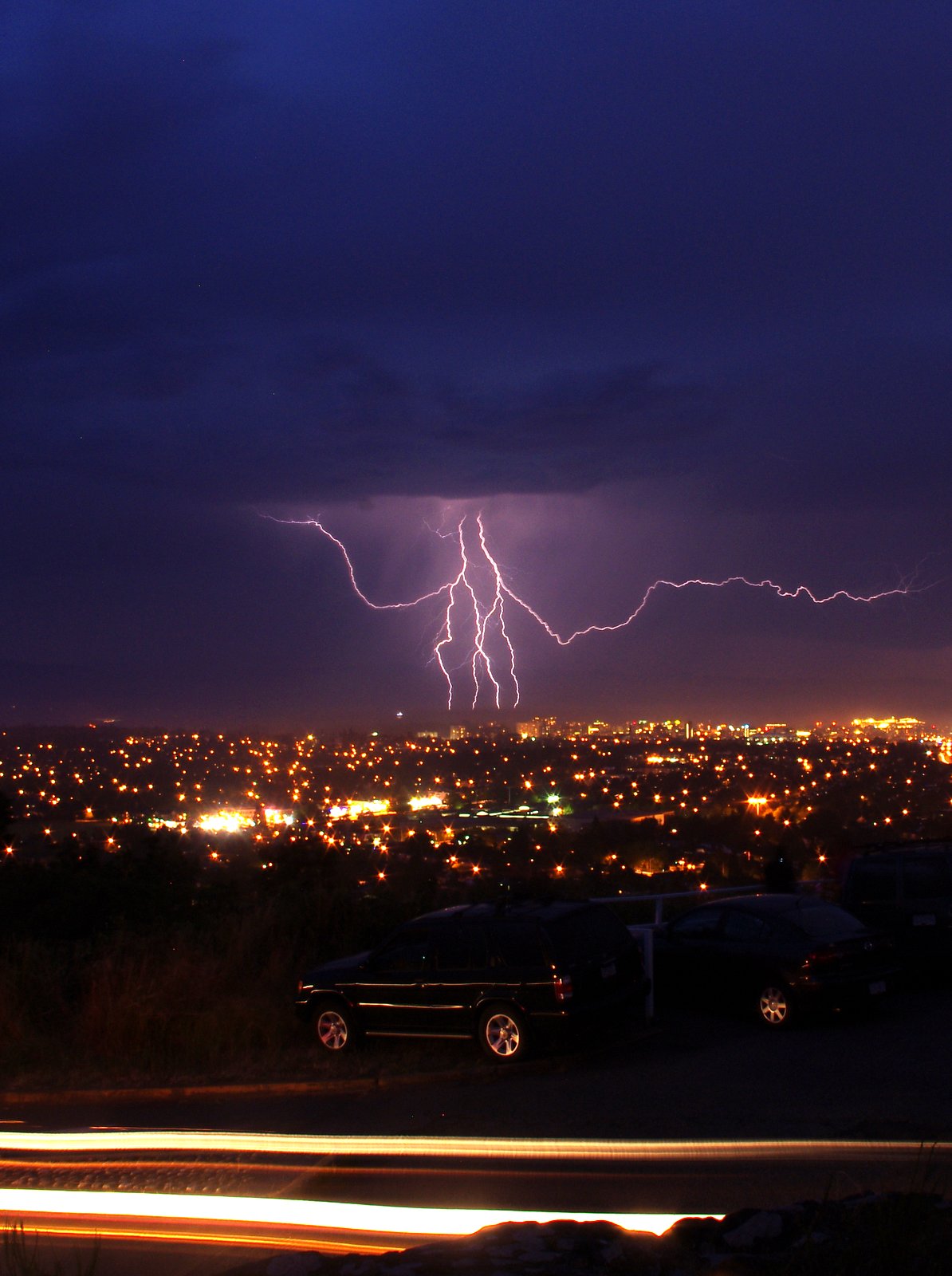
Lightning!
Victoria does not get a lot of lightning. It is a very rare thing to see in Victoria, and most of the time it is way off on the horizon.
This past Friday night, on the 13th in fact, there was a huge thunderstorm which went on for hours. It was all around for many kilometers in every direction, as well as right overhead.
Like any smart city dweller who sees very little lightning, I, along with many many others flocked to the top of the highest hill in Victoria to get a better view. Unlike many however, I stayed well away from the very top, and made sure not to sit on the gigantic metal railings which surround the parking lots and provide an excellent place to sit when there is not an electrical storm.
At first it was still light out, but after an hour or so, the sun set in a truly spectacular fashion.
Not long after that marvellous spectacle, the conditions got just right for lightning photography. The way you do it is to set up the camera on a tripod, point it in a direction with lots of flashes, compose a nice foreground, and set it to take 30 second or so exposures. Keep pressing the shutter until you get something!
Here are some of the results.
Not exactly astrophotos, but I think they are really neat, and I wanted to share them with you.
July 20, 2012
July 19, 2012
Artsy Fartsy Me
This one is a bit more of an artsy shot than an astrophoto, but I think it is worth sharing with the world.
This was a magnificent sunset last week from the top of Mt Tolmie. It was one of the more spectacular sunsets I have ever seen, not the least because it took place during a rare Victoria thunderstorm.
July 18, 2012
Stars in the Back Yard
I took this just last night from outside my back door. I lay on my back with my camera set up on the tripod right beside me, put on some nice quiet Beatles tunes and just generally chilled out for 20 or so minutes while the series of 41 photos were shot.
Then I smushed them in the magic smushing program, and here is the final product.
July 17, 2012
Milky Way Again
Here is another one!
As you can probably guess this is another one of the Milky Way.
This one was taken a bit later, at about one in the morning actually from the top of Gonzales Hill.
I really like these Milky Way shots, so I am going to probably do some more of them. They are a fun new thing to play with.
As you can probably guess this is another one of the Milky Way.
This one was taken a bit later, at about one in the morning actually from the top of Gonzales Hill.
I really like these Milky Way shots, so I am going to probably do some more of them. They are a fun new thing to play with.
July 16, 2012
Rocks and Reflections - Like
Five in a row - woot!
There is nothing extraordinary about this picture, but I kinda like it. I like the wave crashing around the rocks, and the lights on the water.
July 15, 2012
A Way Growing out of the Olyimpics
Wow, this is almost becoming a pattern again!
Here is another one of the Milky way. This is actually one of the shots from the picture with all the startrails from a few days ago.
I tweaked the colors a little bit to make the Milky Way stand out a bit better.
Here is another one of the Milky way. This is actually one of the shots from the picture with all the startrails from a few days ago.
I tweaked the colors a little bit to make the Milky Way stand out a bit better.
July 14, 2012
Two Chairs on a Rock
I have long wanted to take a picture of this locale. I love the blue and red chairs out on the rock there. I have driven by many a time, but have never had my camera, or the weather wasn't good, or all manner of other excuses. In the background are a lighthouse, a big ship, some towers with lights on them all in front of the Olympic Peninsula.
July 13, 2012
Milky Way
Another post! Its a miracle!
This photo is of the Milky Way. You can see it stretching gracefully from the bottom right towards the top left.
You might be thinking, wait, are not all the stars in these pictures in the milky way? You would be right, they are all in our galaxy, the milky way. What we are seeing in this picture is the plane of the galaxy.
Our galaxy is a spiral galaxy. One thing that means is that it is flat like a disk. When we see the dust lanes and dense stars like there are in this image, we are looking directly along the plane of the galaxy.
To see this, it needs to be very dark. In Victoria there are not many place to see it, you kinda need to get down to Cattle Point or something very late at night. on a clear day in the summer.
If you can see it, it is spectacular. In the northern hemisphere it is not nearly as dramatic as the southern hemisphere as from the north we can only see out towards the edge of the galaxy rather than in towards the center, but on a good night it is wonderful.
After I wrote this, I sent some of these pictures to my astronomy prof for his viewing pleasure. He saw that I had been looking at Sagittarius, and told me about a nova that had happened a few days ago in Sagittarius. After much searching I have found it in this photo.
Click on the photo to get the larger version. I put two red boxes in the photo. At the very center of the small one is the nova. A small white dot.
The nova is called N 2012 Sag No 4. A nova is a huge explosion on the surface of a star. It is not a supernova when the entire star explodes, but is just on the surface. They happen when a white dwarf star in a binary system has a companion which overflows its Roche lobe. That means that the larger star transfers hydrogen and helium into an accretion disc around the white dwarf. The stuff in the disc falls down onto the white dwarf and piles up. Eventually, if enough stuff lands on it in just the right way, it will flare up, and become very bright for anywhere between 5 and 80 days.
Here is a close up of the area of the large box with the white dot in the center of the small box clearly visible.
Kinda geeky I know, but hey, Its what I do!
This photo is of the Milky Way. You can see it stretching gracefully from the bottom right towards the top left.
You might be thinking, wait, are not all the stars in these pictures in the milky way? You would be right, they are all in our galaxy, the milky way. What we are seeing in this picture is the plane of the galaxy.
Our galaxy is a spiral galaxy. One thing that means is that it is flat like a disk. When we see the dust lanes and dense stars like there are in this image, we are looking directly along the plane of the galaxy.
To see this, it needs to be very dark. In Victoria there are not many place to see it, you kinda need to get down to Cattle Point or something very late at night. on a clear day in the summer.
If you can see it, it is spectacular. In the northern hemisphere it is not nearly as dramatic as the southern hemisphere as from the north we can only see out towards the edge of the galaxy rather than in towards the center, but on a good night it is wonderful.
After I wrote this, I sent some of these pictures to my astronomy prof for his viewing pleasure. He saw that I had been looking at Sagittarius, and told me about a nova that had happened a few days ago in Sagittarius. After much searching I have found it in this photo.
Click on the photo to get the larger version. I put two red boxes in the photo. At the very center of the small one is the nova. A small white dot.
The nova is called N 2012 Sag No 4. A nova is a huge explosion on the surface of a star. It is not a supernova when the entire star explodes, but is just on the surface. They happen when a white dwarf star in a binary system has a companion which overflows its Roche lobe. That means that the larger star transfers hydrogen and helium into an accretion disc around the white dwarf. The stuff in the disc falls down onto the white dwarf and piles up. Eventually, if enough stuff lands on it in just the right way, it will flare up, and become very bright for anywhere between 5 and 80 days.
Here is a close up of the area of the large box with the white dot in the center of the small box clearly visible.
Kinda geeky I know, but hey, Its what I do!
July 12, 2012
Big Long Startrails
I know that I have kinda stopped writing much on this blog, and that makes me sad, but I am just really busy and tired when I get home from work. I just thought I would post this in case anyone is still looking at this blog at all. I have a few more that I will post over the next few days as well
This one is a startrail shot that I have been meaning to take for a long time. This exposure is 1590 seconds total, but is actually a composite of 53 images taken all in a row.
There are all sorts of neat things in this picture I think. First off, the startrails. As you can see, the middle of the picture has straight trails, and towards the top and bottom there are curved trails.
This is because the celestial equator runs through the middle of the photo. The stars on the bottom are curving to go around the southern celestial pole, and the ones at the top will go around Polaris at the northern celestial pole.
There are also some cool man-made things in the photo. The most obvious are the airplanes going in and out of Seattle in the bottom left corner. There is also a trail from a satellite which comes right down the middle of the picture.
This one is a startrail shot that I have been meaning to take for a long time. This exposure is 1590 seconds total, but is actually a composite of 53 images taken all in a row.
There are all sorts of neat things in this picture I think. First off, the startrails. As you can see, the middle of the picture has straight trails, and towards the top and bottom there are curved trails.
This is because the celestial equator runs through the middle of the photo. The stars on the bottom are curving to go around the southern celestial pole, and the ones at the top will go around Polaris at the northern celestial pole.
There are also some cool man-made things in the photo. The most obvious are the airplanes going in and out of Seattle in the bottom left corner. There is also a trail from a satellite which comes right down the middle of the picture.
Subscribe to:
Posts (Atom)