Here is another view of that spectacular alignment of last weekend. This was taken just as it was about to slip away into the sunrise at about 5:30 in the morning.
Pictured are Venus at the bottom left, the moon in the middle, and Jupiter at the top right.
This one I took from the top of Mount Tolmie on my way to bed. I tend to like to get to bed before the sun rises just on a matter of principle.
Showing posts with label Mt Tolmie. Show all posts
August 15, 2012
July 21, 2012
Lightning!
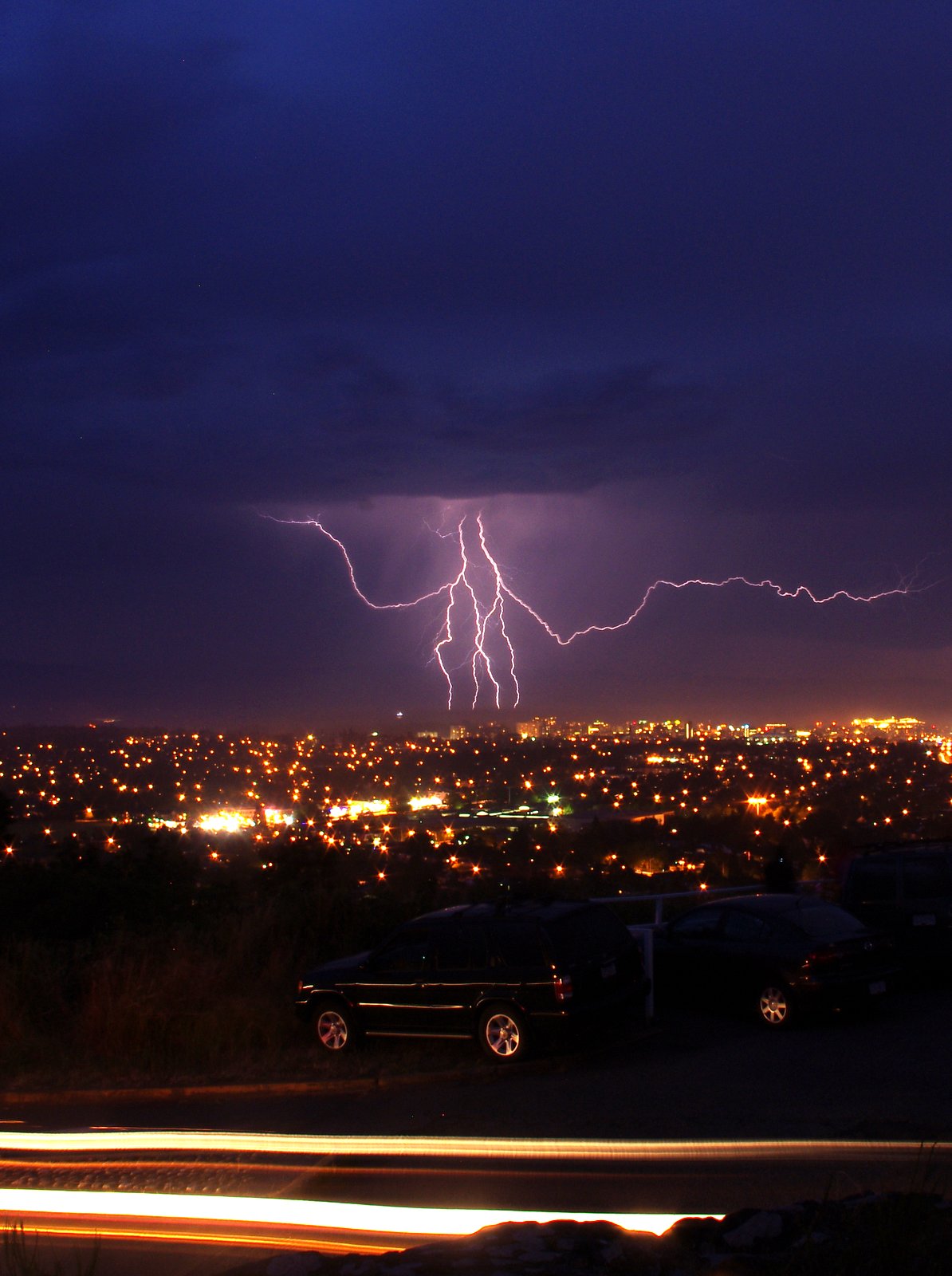
Victoria does not get a lot of lightning. It is a very rare thing to see in Victoria, and most of the time it is way off on the horizon.
This past Friday night, on the 13th in fact, there was a huge thunderstorm which went on for hours. It was all around for many kilometers in every direction, as well as right overhead.
Like any smart city dweller who sees very little lightning, I, along with many many others flocked to the top of the highest hill in Victoria to get a better view. Unlike many however, I stayed well away from the very top, and made sure not to sit on the gigantic metal railings which surround the parking lots and provide an excellent place to sit when there is not an electrical storm.
At first it was still light out, but after an hour or so, the sun set in a truly spectacular fashion.
Not long after that marvellous spectacle, the conditions got just right for lightning photography. The way you do it is to set up the camera on a tripod, point it in a direction with lots of flashes, compose a nice foreground, and set it to take 30 second or so exposures. Keep pressing the shutter until you get something!
Here are some of the results.
Not exactly astrophotos, but I think they are really neat, and I wanted to share them with you.
July 19, 2012
Artsy Fartsy Me
This one is a bit more of an artsy shot than an astrophoto, but I think it is worth sharing with the world.
This was a magnificent sunset last week from the top of Mt Tolmie. It was one of the more spectacular sunsets I have ever seen, not the least because it took place during a rare Victoria thunderstorm.
May 5, 2012
Dark to Light
This one is a bit different. I found a program that stitches together panoramas with the click of just a few buttons. I took this photo quite a while ago now from the top of Mt Tolmie at sunset. If you click on the image it will get a lot bigger. The image spans just over 180 degrees of sky looking from the still bright west to the already dark east.
April 25, 2012
April 18, 2012
A Flare of the Iridium Type
Another iridium flare. This one happens to have been caused by the satellite Iridium 60. It was launched March 30th 1998 from Vandenberg AFB in California aboard a Delta II rocket along with four of its iridium buddies.
Like all the Iridium satellites this one is a communications satellite for satellite phones. It is in a polar orbit going from pole to pole and back in about 100 minutes. It is in orbit almost 800 km above the earth.
I don't have much else to say about this picture. I took it on saturday night from Mt Tolmie. It was a 30 second exposure.
Like all the Iridium satellites this one is a communications satellite for satellite phones. It is in a polar orbit going from pole to pole and back in about 100 minutes. It is in orbit almost 800 km above the earth.
I don't have much else to say about this picture. I took it on saturday night from Mt Tolmie. It was a 30 second exposure.
April 16, 2012
Cloud on a Skewer
After scrambling to catch the ISS on Friday, I set out to do it properly on Saturday. This pass was not quite as bright, and it was a bit cloudy, but I think the clouds just added to it.
I think it looks like the cloud has been skewered by the streak of the ISS. In fact, the space station is a few hundred kilometers above the clouds.
It just strikes me as amazing the fact that there are people in there traveling around the earth at 7 kilometers a second.
If you too want to see the ISS there is an easy way to do it. First you need to open Heavens Above. The link is on the right side of the page. Once there you need to set your location and time zone as well as your elevation. That is all done in the configuration section at the top.
After that there are a whole bunch of different categories to choose from. They all show places and times where you can see bright satellites passing overhead or iridium flares or whatnot. There are also lots of pages of information about the planets.
Click on 10 day predictions for ISS. The table it brings you to lists all of the visible passes for the next ten days. Occasionally there will be a period with none. This happens when the station only passes over during the day or when it is in the earths shadow. These periods never last more than a week or so. When you find one you want to go see, click on the date.
That gives you all the information about the pass. I find the star chart to be particularly useful. I like to find a few easy points along it to identify, such as planets or bright stars so that I can figure out where it will go. Plan on being ready a few minutes early especially if you are going to be taking photos. Set the camera up at a point you know the station will pass through, then look for little moving dots in the sky along its path.
ISS is usually pretty bright so it is relatively easy to find, especially if you know where it is going to be. Make sure you are watching carefully as it only takes a few minutes to go across the entire sky. If you want a real challenge try to catch an iridium flare. Although they are brighter, they only last about 30 seconds or so and before and after the flare you cannot usually see the satellite. To take a picture of one you need to have the camera set up pointing at just the right place. Then to time it so you get the whole flare is pretty tricky too.
I think it looks like the cloud has been skewered by the streak of the ISS. In fact, the space station is a few hundred kilometers above the clouds.
It just strikes me as amazing the fact that there are people in there traveling around the earth at 7 kilometers a second.
If you too want to see the ISS there is an easy way to do it. First you need to open Heavens Above. The link is on the right side of the page. Once there you need to set your location and time zone as well as your elevation. That is all done in the configuration section at the top.
After that there are a whole bunch of different categories to choose from. They all show places and times where you can see bright satellites passing overhead or iridium flares or whatnot. There are also lots of pages of information about the planets.
Click on 10 day predictions for ISS. The table it brings you to lists all of the visible passes for the next ten days. Occasionally there will be a period with none. This happens when the station only passes over during the day or when it is in the earths shadow. These periods never last more than a week or so. When you find one you want to go see, click on the date.
That gives you all the information about the pass. I find the star chart to be particularly useful. I like to find a few easy points along it to identify, such as planets or bright stars so that I can figure out where it will go. Plan on being ready a few minutes early especially if you are going to be taking photos. Set the camera up at a point you know the station will pass through, then look for little moving dots in the sky along its path.
ISS is usually pretty bright so it is relatively easy to find, especially if you know where it is going to be. Make sure you are watching carefully as it only takes a few minutes to go across the entire sky. If you want a real challenge try to catch an iridium flare. Although they are brighter, they only last about 30 seconds or so and before and after the flare you cannot usually see the satellite. To take a picture of one you need to have the camera set up pointing at just the right place. Then to time it so you get the whole flare is pretty tricky too.
April 15, 2012
Goddess in a Tree
It was sure a beautiful night on Friday. After I rushed up and took the photo in the last post, I set up my telescope to take a look at Saturn. I also took some photos of Venus.
Venus is in the tree in on the right. A car going by left some cool light streaks on the left and the city lights make some interesting colors in the sky, I quite like this photo if I do say so myself. The trees look so weird and alien...
March 18, 2012
Passing in the Night
Venus is no longer below Jupiter in the evening sky. Jupiter has overtaken Venus for the time being in their eternal march across the sky. This particular picture is from the night of the 13th, 5 days ago. From Mount Tolmie there was a great view of the two planets sidling up to each-other. I went for the wide angle with this picture, and surprised myself by actually getting all of Orion in the photo along with the planets. The hunter is joined by the head of Taurus, and by the Pleiades to round out the major participants in this piece of stellar art.
March 16, 2012
Jupiter and Venus, Together
This photo is from the 6th of this month. I took it from near the top of Mt Tolmie. I wanted to try and get a photo with Mercury as well, but the clouds completely blocked it from view. In the picture are Jupiter and Venus. Venus is the lower and brighter of the two white dots. Venus is just nearing its greatest eastern elongation which it will reach on the 27th of March. That is the date when it is the farthest away from the sun in the evening sky, and also the day that it will remain above the horizon the longest. After the 27th it will start appearing closer and closer to the sun until on the 5th and 6th of June it makes a transit of the sun.
Looking through a telescope, you can see that Venus looks like a quarter moon. As the days go on, past the 27th, it will star turning into a sliver and getting smaller and smaller until on the day of inferior conjunction, we cannot see any of the planet illuminated. After that throughout the summer it will get fatter and fatter until on the 15th of August it will be half illuminated again, this time visible in the hours before sunrise. As it continues on, it will continue to get more and more lit up, but it will be going around the sun and getting further and further away and it will get dimmer and closer to the sun once again.
Even with the most advanced telescopes Venus is just a featureless dot. The atmosphere is so thick that to see through it you need to send a space craft there and use radar to map the surface. Venus is so hot and the atmosphere so thick that on the surface there is the same pressure as being a kilometer beneath the ocean on earth at a temperature of 460 degrees celsius. If you had infinite money and resources, you could build cities that floated on the ocean of air at 50km above the surface where the temperature and pressure are just about the same as on earth. Unfortunately, the atmosphere is also made of about 96% carbon dioxide.
Looking through a telescope, you can see that Venus looks like a quarter moon. As the days go on, past the 27th, it will star turning into a sliver and getting smaller and smaller until on the day of inferior conjunction, we cannot see any of the planet illuminated. After that throughout the summer it will get fatter and fatter until on the 15th of August it will be half illuminated again, this time visible in the hours before sunrise. As it continues on, it will continue to get more and more lit up, but it will be going around the sun and getting further and further away and it will get dimmer and closer to the sun once again.
Even with the most advanced telescopes Venus is just a featureless dot. The atmosphere is so thick that to see through it you need to send a space craft there and use radar to map the surface. Venus is so hot and the atmosphere so thick that on the surface there is the same pressure as being a kilometer beneath the ocean on earth at a temperature of 460 degrees celsius. If you had infinite money and resources, you could build cities that floated on the ocean of air at 50km above the surface where the temperature and pressure are just about the same as on earth. Unfortunately, the atmosphere is also made of about 96% carbon dioxide.
January 28, 2012
Lights in a Sea of Darkness
Sunset is a beautiful thing. Last night I spent a few hours perched on the side of Mt Tolmie watching the sun go down and the stars gradually appear. About half way through this video, at the top of the screen near the center, you can see Venus appear and gradually get brighter. If I had stayed out for another couple hours, Venus would have followed the sun below the horizon, then the moon, and then Jupiter. All were lined up neatly in the western sky.
This video consists of nearly 200 photos taken every 30 seconds or so from 4.30 pm to 6.30 pm. I wanted to stay longer, but my hands no longer had any feeling in them, and the battery on the camera was succumbing to the cold.
January 13, 2012
The Northwestern Sky
Looking to the north west from Mt Tolmie in Victoria, this is what you would have seen at 7.30 in the evening last night. One of the more prominent stars in the frame is Deneb. If you go up from the bright star just abobe the tallest tree, and follow it almost strait towards the top of the picture, the next bright star is Deneb.
Deneb is in the constellation Cygnus, and is in fact the constellations brightest star. It is also one of the corners of the Summer Triangle, made up of Deneb, Vega, and Altair, all bright stars hight in the summer sky.
To make the photo I used my lens set at 18mm, f/5.0, ISO 400, and an exposure length of 58 seconds.
Subscribe to:
Posts (Atom)